
The Ultimate Despair
And fuck you Monokuma

One of my earliest exposures to the Japanese film industry was the original Battle Royale. Like most kids that watched the film prior to its legal re-releases in the US, I found a rip of it on some website and had a blast. The concept of a government so afraid of youth, progress, and sacrificing their power that they make a spectacle of killing children has continually stuck with me since and, unfortunately, grows more prescient by the day. The problem with being introduced to the concept of a “battle royale” through Battle Royale, though, is that none of its imitators hit the same…except one.
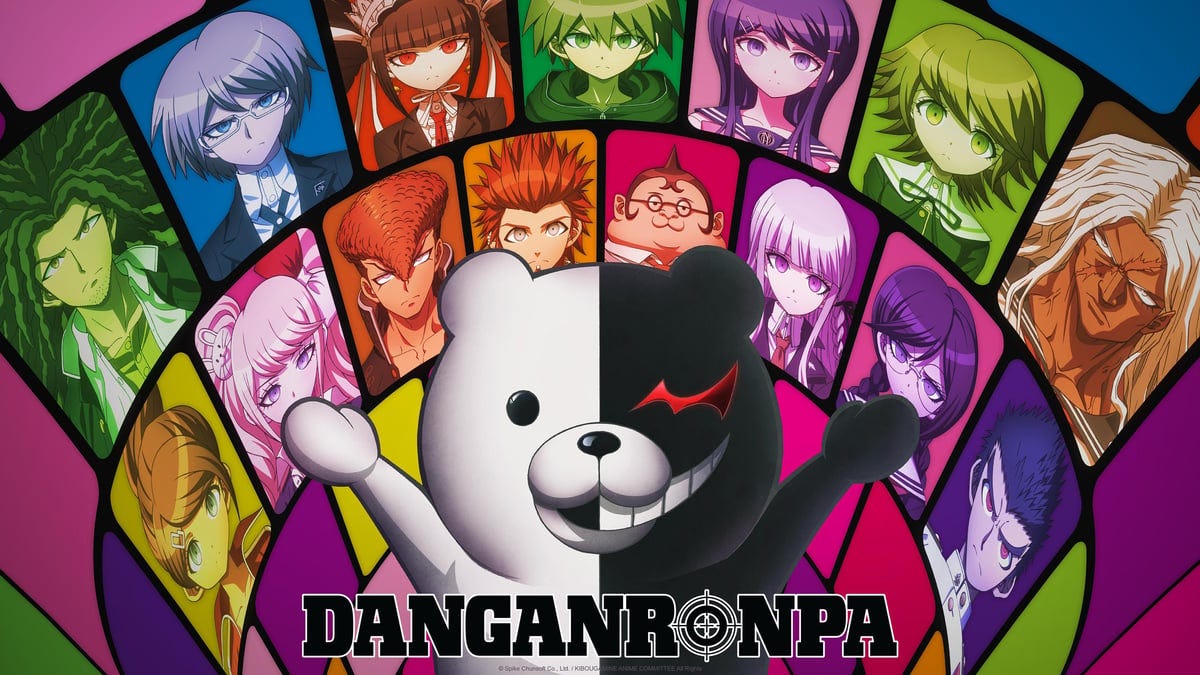
It wouldn’t be a blog about embracing my cringe interests if I didn’t address the Danganronpa-shaped elephant in the room. I’ve been a fan of the series for about ten years now although I don’t really discuss it much. Unlike a bunch of video games I do often bring up in conversations, the Danganronpa series was both unrelated to my field of study and does not have any film adaptations I can invoke to make it relevant. Plus, I’m more than aware that this is a series that is absolutely not for people that haven’t been in the trenches of anime bullshit: there’s too many upskirts and accidental titty grabs for that. However, in light of the “new” game releasing and me finding the remastered original trilogy for a fantastic price, I’m still going to try recommending it to you dear reader.
For those unfamiliar, the Danganronpa series comprises of three main games, six side games, three anime adaptations, and a whole slew of manga all of which have some input from Kazuma Kodaka: a man unafraid to show the world exactly what he’s into. The main games each follow a group of students attending the prestigious Hope’s Peak Academy. The school only accepts the best of the best (henceforth referred to as Ultimates), a few lucky normies through a lottery system, and anyone with parents willing to front a massive bill for the Hope’s Peak name on their kid’s high school diploma. However, a student can be an Ultimate in pretty much any field whether it be an acquired skill like the Ultimate Nurse or Ultimate Pianist or something a bit more out-there like Ultimate Princess or Ultimate Magician. Your player character is always….none of these things; they’re always a normie amongst the greats. But this status difference doesn’t matter quite as much when your school’s become a prison and you’re forced to either stay perpetually stuck in high school or kill each other to get out.
Beyond the Battle Royale ties, kids killing kids due to a dystopian national power, the first Danganronpa game always stuck with me because of the deductions. My earliest video games on my little DS Lite were all puzzle-solving games—Brain Age, Professor Layton, Ace Attorney, etc.—which has kind of shaped my taste in games…forever. I love a point and a click and a search for clues which are the primary set of mechanics. The difficulty curve between each case feels natural, even when a curveball like a double murder shows up. Most of the clues never feel too hidden and the cases don’t require wild leaps of logic. Setting each game in a school immediately provides a reasonably large building with multiple areas to explore which is also a pretty consistent boon. The art style of all the games, with its heavy contrast between blacks and neons, makes exploring all the more fun. The flashiness particularly sticks out when the class trials start up: an elaborate affair in which a gaggle of minigames and deductions eventually lead to the grisly death of the “Blackened” killer.
Honestly, I can’t think of a bad case (in terms of mechanics specifically) in the first or second games. Danganronpa V.3, the only game I haven’t finished, is the only game I can think of where the cases are just…sort of bullshit? Not quite obtuse, but just not as fun for whatever reason. I’m willing to admit that all the games have some side modes (Monokuma Theatre) that I could live without. But even the side game, Ultra Despair Girls, has some better cases regarding deductions in my opinion. However, I’m more than willing to admit my bias for the cases in some games largely comes down to the characters they revolve around.
The actual mechanics of solving cases are really only half the story in the Danganronpa series because the games are murder/mystery visual novels. Basically, that means most of the “action” is relegated to animated scenes and text prompts. So, for a successful visual novel, the player character and supporting cast should be compelling at minimum. To a point, I think most of the Danganronpa games succeed at this—even if more than a few characters are memorable because of how reprehensible they are.
I’m more than willing to admit that nostalgia definitely plays into my bias towards the first Danganronpa cast. It’s the only cast I could confidently name every character off the dome and the cast where I genuinely have a pretty deep love for most of them. Emphasis on most: Ultimate Psychic Hiro and Ultimate Doujin Creator Hifumi can kick absolute rocks, and Ultimate Idol Sayaka is a bit forgettable. Everyone else? Pretty cool. Great ensemble, great character interactions. This is the game that introduces the menaces to society that are Monokuma—the fucked up robotic bear “headmaster” whose voice rings in my ears like a curse—and the baddie of all time Junko Enoshima. I’m also quite partial to Ultimate Programmer Chihiro and Ultimate Martial Artist Sakura, who are both unfortunately done quite dirty in-game and by the fanbase. Ultimate Writing Prodigy Toko Fukawa, another victim of some bad writing ironically, does have her moments as well—especially after spending a semester with creative writing majors. And, of course, Ultimate ??? Kyoko Kirigiri is… probably the best written girl in the whole series. While I think Makoto, the player character, is quite bland in comparison, but that’s both part and parcel for visual novel player characters and in-line with his character’s function in the story. Makoto’s the only “normal” student is a class of Ultimates, of course he’ll seem bland in comparison. But, his blandness makes his (your) deductive skills and tenacity to beat the odds and survive. That’s what makes the original Danganronpa stand out to me: everyone has a clear-cut motive to stay alive, which makes their choices to either kill out of safety or risk sending their fellow students to a grisly punishment both understandable and poignant.
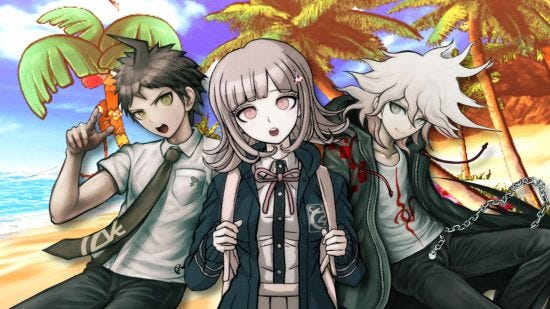
Danganronpa 2 is a bit more of a mixed bag for me. There are several characters I adore and easily make my Characters of All Time list, but more of the cast tends to slip my mind. The more elaborate lore and plot twists added to this game probably aids in the disparity: characters killed early on simply get buried after the bigger machinations of the story are revealed. Again, that’s not to say the characters are unmemorable in any way. Ultimate Animal Breeder Gundham Tanaka’s unnecessary bravado is entertaining (a friend’s undying love for him also contributes to his memorability). Ultimate Gamer Chiaki Nanami was initially quite unremarkable for me, but her roles in later media really flesh her out beyond a genki gamer girl. Ultimate Yakuza Fuyuhiko Kuzuyuru and Ultimate Bodyguard Peko Pekoyama have a very touching bond, and Ultimate Nurse Mikan Tsumiki takes over Toka’s role as the character that intrigues me but the writing does her so dirty. But, the true stars of the show are Ultimate Lucky Student Nagito Komaeda and your player character Hajime Hinata. Unlike Makoto, Nagito’s luck does not come from a lottery but rather an infinite cycle of fantastic luck followed by a tragic event. His massive inferiority complex, masochistic urges, and wet cat-like appearance bewitch and captivate me. And, unlike Makoto, Hajime’s got a personality. These two character’s clashing ideologies—Nagito’s raving misplaced search for hope and Hajime’s pragmatic approach to unity—are really what carry the narrative. Sure, some people take it as yaoi-bait but I genuinely enjoy the depth of their interactions and what it brings to the twists that come in the late game.
I don’t know if my ravings are enough to really convince anyone to play this series. Like I said, there’s some slow parts and enough frivolous upskirt shots that I don’t blame anyone for skipping out. But, as far as both visual novels and Battle Royale clones go, the Danganronpa series has been a favorite of mine for nearly a decade now. Yes, it is cringe. But I am free.